
The Tenant
Purists in Literature — III

Purists in Literature — III
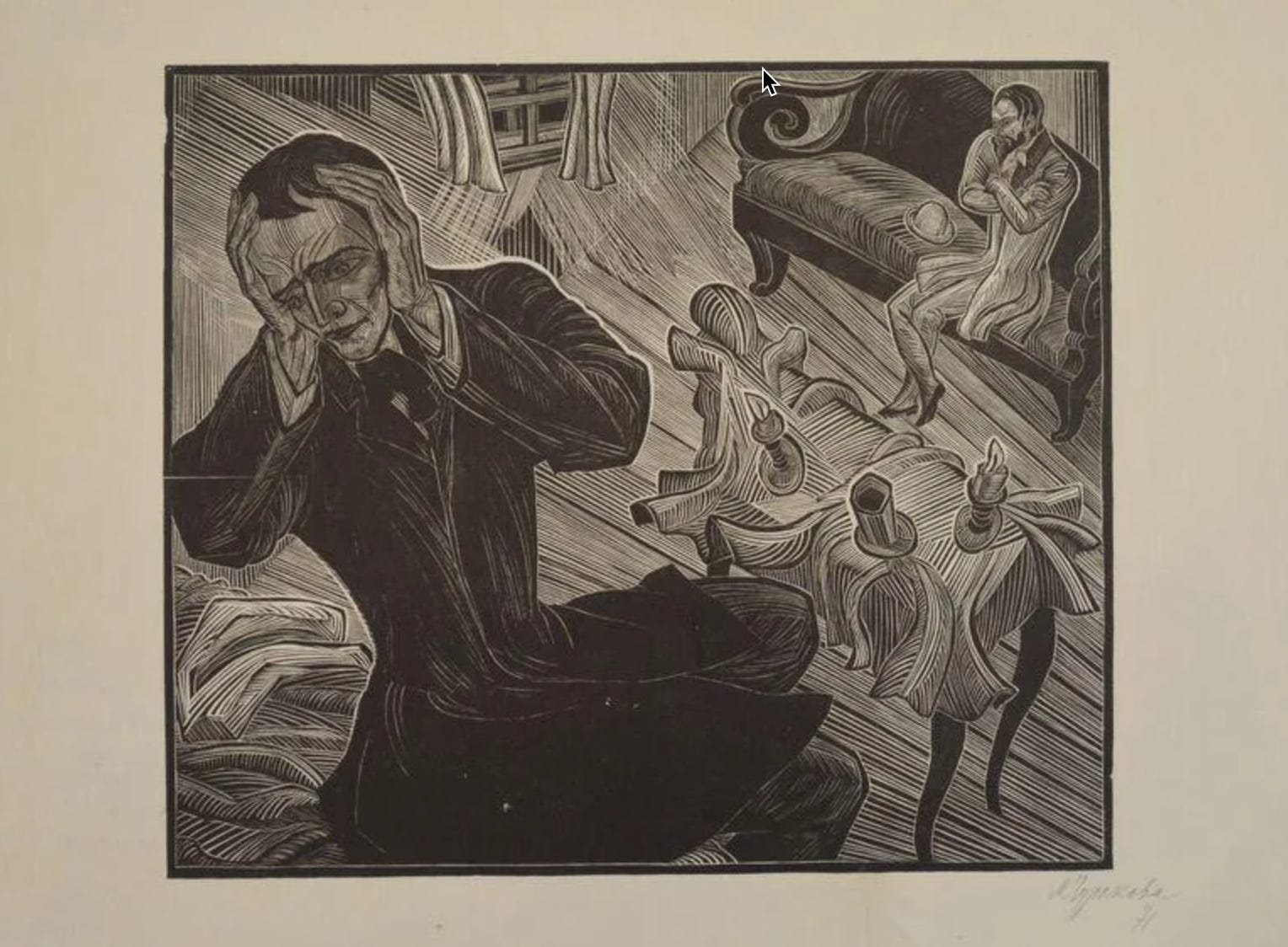
The rain has been at the glass since afternoon. It gathers in wavering sheets that blur the roofs opposite until the whole street seems to dissolve and return. It taps at the glass like little soaked children desperate to get inside. The room holds smells of damp wool and the medicinal sweetness of fever.
Ivan’s head has become too heavy for his own neck. Every attempt at thought arrives carrying its own echo. The pulse behind his eyes no longer beats so much as presses, steadily, as though someone on the other side of his skull has forgotten to remove a heavy thumb. He’s been at the window twice already without remembering having stood, clenching the velvet curtain in his fist.
At some point, without Ivan having heard the door, there was a man in his chair — thin, wearing Ivan’s own dressing gown, his hand already at the sugar tongs, steeping tea — whether there was any lemon, a thing he wondered aloud. He sat up slightly, adjusted the chair a quarter turn toward the window, and remarked that the weather had settled in for the night. Outside the rain continued its work against the glass.
A name — Ivan didn’t ask for one. Perhaps it was the rain, the fever. Both. To demand an identity is to grant the specter reality, and he could not afford, tonight of all nights, for this particular thing to be real.
Faced with the unbearable offense of devilry that refuses to cooperate — already familiar with the samovar — Ivan reaches for his oldest armor and flings the grandest moral credentials he owns at the man wearing his clothes.
He speaks of the children. Of the little girl beaten in the outhouse, her small fists against the timber while her mother slept. Of the boy loosed to the dogs in the frost for stealing a turnip, torn apart while the general watched on horseback, his breath making small clouds in the cold. He lays out the ledger of human agony like a shield. If he can remain the tragic defender of the innocent, he doesn’t have to become the man who permitted his father’s throat to be cut.
The visitor listened with polite, agonizing patience, waiting for the fury to pass so he could savor his tea.
He mentioned the poem — the one about the prisoner and the old man in the cell. He’d found it moving after all and had turned the last stanza over for some time and wondered if Ivan had ever considered it from a different angle. He stirred sugar into his tea, longer than necessary, the spoon turning and turning against the glass until the sound filled the room.
Ivan, decidedly: pray tell why children suffer.
The visitor thanked him for the tea.
Ivan had forgotten offering any.
Ivan presented the argument again. The visitor listened again, with the same evident interest, the same complete and courteous imperviousness to being cornered. He knew everything Ivan knew. Spoke in Ivan’s own cadences. Was even wearing Ivan’s own logic like his dressing gown, and he’d been sitting across from Ivan for years, and he was in no particular hurry, and outside the window it was still the same rain.
Frustration exceeded patience. The grip of the fever was at its zenith. Ivan’s arm moved before he did. It’s the fate of glass to break.
Neither of them looked toward it.
That frightened Ivan more than the sound.
The visitor soon left the way he arrived — without ceremony and without the door, the chair slightly displaced behind him. Tea cup sweating. He hadn’t answered a single question. The room was the same room it had been before he came, and the dressing gown was hanging where it always hung, and the only evidence that anything had happened at all was a glass on the floor that Ivan had thrown at something he could not prove was there.
By morning the chair will be exactly where it belongs.
The veil, if lifted, would not make Ivan more certain of what lies behind it.
Fyodor Dostoevsky, The Brothers Karamazov (1880)